
Hi @james
now switched to Hetzner Cloud DNS, and the renewal worked. Thanks!
Having used the manual wildcard config forever, I however still don't understand, how the first set of certs had been issued, that expired back in February.
Hi @james
now switched to Hetzner Cloud DNS, and the renewal worked. Thanks!
Having used the manual wildcard config forever, I however still don't understand, how the first set of certs had been issued, that expired back in February.
Hi @james
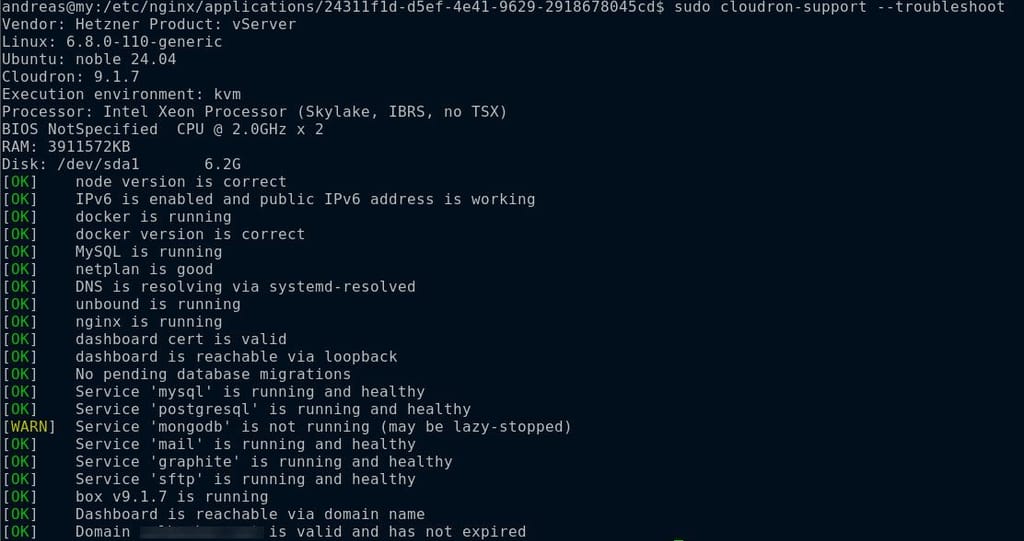
ps all other app certs seem to be renewed correctly, I haven't observed any issues here
sorry for replying late:
there's no cron job involved, maybe that's the issue?
Everything needs to be done manually:
after running the start script, and using your ps-check command, I see a corresponding process. Additionally, running <occ notify_push:metrics> in a Cloudron terminal shows it works, all indicated stats are up-to-date and change over time.
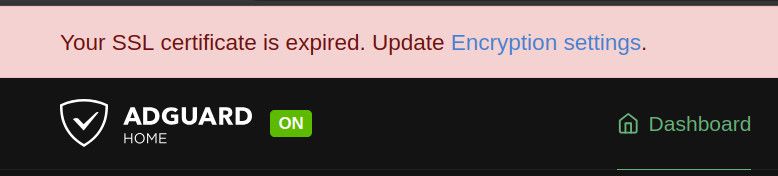
2026-04-30T12:04:23.234Z reverseproxy: ensureCertificate: error: no http challenges
Am I facing the issue @girish described here?
Any idea how to fix this?
Thx in advance!
I've been following the instructions in threads cited below, and it looks like notify_push is up and running
Dear all
just to confirm: the update broke my installation, and the documented recovery procedures (https://docs.cloudron.io/packages/nextcloud/#fixing-a-broken-install) didn't work. The logs indeed showed issues with groupfolders. I restored backup and will be waiting for a second try

cleaning up the docker images as mentioned above basically works.
On my instance, there however are two app docker images that are much larger than the others:
rallly (almost 6GB), loomio (>6GB)
Is this size "normal"?
Is the "normal" size of the apps' docker images documented anywhere?
I installed documize and try to login using the credentials from the "first time using" doc, as well as a cloudron user - login however is not possible, the trace shows a 401 "Unauthorized" on this target URL: https://documize.mycloudron.domain/api/public/authenticate/ldap
Ideas, anyone?
@nebulon
as said, there's no real problem right now, still I don't understand the behaviour and am curious.
you're talking about accessing the Cloudron through entering the IP (192.168.x.y) in the browser?
It's clear that this wouldn't work and this is not what I'm doing, it's a little more complicated:
I don't understand why. Shouldn't the use of external VPN service make the internal source IP invisible?
thx for everybody's inputs and sorry for my delay - took some time testing, and here's my wrap-up.
on the Fritzbox
as a result, access from internet IPs works and the Cloudron as well as all apps are reachable.
Still, if accessed from a computer within Fritzbox-Network (192.168.x.y), neither app, nor the Cloudron respond. Instead, the already mentioned Fritzbox access page shows.
So it's not perfect, but usable and my question is answered.
@subven said in cloudron ssl behind fritz!box:
You said you do not use a DNS provider
not one of the "automated" ones like Cloudflare but Cloudron's "custom" way. but of course, the domain is registered

@nebulon yes, had read that in another thread before, and still it doesn't work in my case - no idea why not.
Only when trying to access the cloudron UI through "my.xxx.yyy", all browsers I tested (firefox, edge, opera, brave) throw "insecure connection", and the certificate presented is the self-signed one of the fritzbox.
I had been wondering if naming plays a role. @nebulon, you did not by chance change the fritzbox's name from the default "fritz.box" to sth else?
@subven said in cloudron ssl behind fritz!box:
As a german, I know what a FritzBox is I think you're still at the wrong path since the exposed host exactly does what it should and the webserver of the Fritzbox does not interfer there.
There is enough information within this thread to fix your problem.
@subven said in cloudron ssl behind fritz!box:
Cloudron does not work without a domain you own or at least can controle.
As said before, the domain is registered and I do control the DNS
@nebulon and one more question: when accessing the cloudron using the internal ip (https://192.168.xxx.yyy), it says "you are seeing this page ... no apps configured for this domain." This is normal, isn't it? the certificate presented here is the self signed one (default.cert). I thought this as well is expected behaviour and does not mean that Let's Encrypt cert renewal doesn't work. Is that right?
@nebulon (and @girish, @subven): fritzbox is a dsl modem that can be accessed from "outside". as @nebulon mentioned, machines from the internal network can be exposed (which is what I did). if the machine is accessed through https however, the first certificate presented seems to be that of the modem, which by standard is a self-signed one, and not accepted by browsers. It however is possible to manually upload other certs to the modem (see this doc). I don't use any DNS provider, a custom setup, the domain is registered and forwarding works properly through dynv6.com. looking at the nginx certs within /yellowtent/platformdata, their timestamp seems to be update each day - and I assume that this is a sign that cert renewal from the cloudron works, right?
Dear all
one of my cloudrons is behind a fritzbox in a personal (sub-) domain. Although dyndns is set and working correctly, the cloudron isn't accessible:
How can I make available the cloudron domain certificate to the fritzbox?
Any other ideas?
Best
Andreas
@ApplegateR didn't read that anywhere. Let me know if you'd like some information from that machine. If not, I will go back to the snapshot in that case later today.