
CCAI : Cloudron Custom App Installer
-
New version : v4.3.2 (git.cloudron.io updated)
Added optional Cloudflare Turnstile support.
Default : not enabled
Edit /app/data/.env to enable and add your config keysThe 'hosted-as-a-service` ccai.appx.uk is now running with Turnstile for anti-bot protection.
If you install this to your own Cloudron, you can choose to run without Turnstile or to enable it.Why Cloudflare Turnstile ?
- easiest / best non-google captcha type anti-bot
- free account with generous free-tier usage
- minimal code dependencies to simplify app building
Beyond this, it would need a user registration or failed login rate limiter.
-
New version : v4.3.2 (git.cloudron.io updated)
Added optional Cloudflare Turnstile support.
Default : not enabled
Edit /app/data/.env to enable and add your config keysThe 'hosted-as-a-service` ccai.appx.uk is now running with Turnstile for anti-bot protection.
If you install this to your own Cloudron, you can choose to run without Turnstile or to enable it.Why Cloudflare Turnstile ?
- easiest / best non-google captcha type anti-bot
- free account with generous free-tier usage
- minimal code dependencies to simplify app building
Beyond this, it would need a user registration or failed login rate limiter.
@timconsidine said in CCAI : Cloudron Custom App Installer:
Cloudflare Turnstile
We had a thread here about CAPTCHA alternatives quite a while ago. One issue with Cloudflare is that it is unfortunately rapidly becoming a single choke-point for the whole internet. I ran a quick AI search for Free Software alternatives to proprietary Turnstile. This is what was suggested:
Several open source alternatives to Cloudflare Turnstile exist, focusing on privacy-friendly bot protection, spam prevention, and user verification without relying on proprietary services. These often use proof-of-work (PoW) mechanisms to verify legitimacy invisibly or with minimal user friction, similar to Turnstile's approach. They are typically self-hostable, allowing full control and avoiding central choke points. Below is a list of notable options, including key features and implementation details.
ALTCHA
Description: A privacy-first CAPTCHA alternative that uses PoW to protect websites, APIs, and forms from spam and bots without tracking users. It's designed for seamless integration and escalates to code challenges only for high-risk cases.
Key Features: Frictionless verification, WCAG 2.2 AA accessibility compliance, support for 50+ languages, no cookies or fingerprinting, and optional Sentinel for advanced threat detection (e.g., rate limiting, ML-based analysis).
How it Works: The widget runs a PoW challenge in the background; if solved, it generates a token for server validation. Self-hostable via Docker, AWS, Azure, or Kubernetes.
Licensing and Cost: MIT license for the core (fully open source and free); Sentinel is commercial for enterprise needs.
Advantages over Turnstile: Smaller bundle size (30 kB vs. 85+ kB), faster load times (0 ms when bundled), and stricter privacy compliance (GDPR, HIPAA, etc.) with no data leakage.mCaptcha
Description: A no-nonsense, PoW-based CAPTCHA system emphasizing user experience and privacy, acting as a drop-in replacement for traditional CAPTCHAs like reCAPTCHA.
Key Features: Seamless UX without image puzzles, robust against NAT users (no IP reliance), API-compatible with reCAPTCHA/hCaptcha, and focused on making bot attacks computationally expensive.
How it Works: Clients solve adjustable PoW challenges; the backend verifies them. It's fully automated and doesn't contribute to third-party ML training.
Licensing and Cost: AGPL for the core, with client libraries under permissive free software licenses; entirely free and open source.
Advantages over Turnstile: Fully self-hosted with no external dependencies, stronger emphasis on not profiling users, and libre software ethos.Cap
Description: A lightweight, modern PoW CAPTCHA using SHA-256 hashes, designed for speed and simplicity as a direct alternative to Turnstile.
Key Features: Invisible and floating modes, standalone REST API for any language/framework, customizable difficulty, and WASM solvers for web/Node.js.
How it Works: The widget generates and solves challenges via Web Workers; the server validates them. Supports checkpoints for progressive verification.
Licensing and Cost: Apache 2.0 license; fully open source and free.
Advantages over Turnstile: Tiny size (12 kB widget), no tracking/fingerprinting, lower error rates, and higher customizability (full backend/frontend tweaks).Anubis
Description: A Web AI Firewall utility that weighs connections with PoW challenges to block scrapers, bots, and DDoS attacks before they reach your site.
Key Features: Heuristic-based bot detection, customizable rules/policies, non-JS challenge support, and integration as a reverse proxy.
How it Works: Responds to requests with a JS (or non-JS) PoW program; only solved challenges grant access. Tunable difficulty makes scraping unprofitable.
Licensing and Cost: Open source (repository on GitHub); free to use and self-host.
Advantages over Turnstile: Explicitly targets AI scrapers and bots, supports broader heuristics beyond PoW, and has been used to mitigate real DDoS incidents.mosparo
Description: A rule-based spam protection tool for online forms, functioning like an email spam filter rather than a traditional CAPTCHA.
Key Features: Checks form data against custom rules, honeypot fields for bot detection, accessibility compliance, and multi-language support.
How it Works: Integrates into forms to validate submissions server-side based on patterns/rules; blocks spam without user-visible challenges.
Licensing and Cost: Open source under a permissive license; free and self-hostable via Docker.
Advantages over Turnstile: Less intrusive (no challenges for legitimate users), focuses on content analysis over behavior, and fully accessible for screen readers/keyboards.Procaptcha
Description: A privacy-focused verification tool redefining CAPTCHA with unique security approaches, often listed as an open source option for bot protection.
Key Features: Emphasizes privacy and security without conventional puzzles; details are limited but include freemium elements for scaling.
How it Works: Uses alternative verification methods (potentially PoW or similar); self-hostable with open components.
Licensing and Cost: Open source with freemium model (free tier available).
Advantages over Turnstile: Open source core allows modifications, though less detailed comparisons are available. -
-
I’m not a fan of Cloudflare - just put it in as fastest way to address a possible vulnerability.
But proof of work is often a pain for users.
I feel there are only 2 good solutions :
Cloudron re-write as an official utility (resolves authentication much more neatly)
CCAI adds user registration
I’m thinking what direction to take it in if not adopted/rewritten -
 J james referenced this topic on
-
Found 2 bugs with latest CCAI
-
After install of one app, still being logged in, it's impossible to click on another app to proceed with installation. Starting over of course requires re-logging in.
-
I was upgrading to 9.0.12 while attempting this so got this:
[9:05:52 PM] [2025-11-26 03:05:51] Failed to install app: 400 message: Box version exceeds Apps maxBoxVersion
-
-
Found 2 bugs with latest CCAI
-
After install of one app, still being logged in, it's impossible to click on another app to proceed with installation. Starting over of course requires re-logging in.
-
I was upgrading to 9.0.12 while attempting this so got this:
[9:05:52 PM] [2025-11-26 03:05:51] Failed to install app: 400 message: Box version exceeds Apps maxBoxVersion
@robi thank you for the report.
I will investigate.
I'm hoping that Cloudron will bring out their own version of this - the app would be so much easier for everyone if logging in was not needed (it was in the dashboard somewhere)I've not updated to 9.0.x yet - waiting for a later release
Indie app dev, scratching my itches : communityapps.appx.uk, portfolio at myca.appx.uk
-
-
@robi thank you for the report.
I will investigate.
I'm hoping that Cloudron will bring out their own version of this - the app would be so much easier for everyone if logging in was not needed (it was in the dashboard somewhere)I've not updated to 9.0.x yet - waiting for a later release
@timconsidine you are welcome.
You can always test on the demo server.
And at least the second issue is easily solved via an expected version bump or just take out the check. Not sure why it's needed. Is it?
-
revive! and...
Thanks @timconsidine for this. I kept coming across CCAI but never looked into it until now. Brilliant approach. I have a few questions.
- Is there a doc/faq page on how to use this in case I want to add an app that isn't listed in the catalog?
- I noticed zoneminder (alpha) in the list - Is it safe enough to install on a production server? (just want to take a peek at it)
- If I install CCAI on my own server - is it pass protected or can anyone access/use it then?
- Q more for @staff what's your opinion on CCAI - will you deploy something similar to it?
-
revive! and...
Thanks @timconsidine for this. I kept coming across CCAI but never looked into it until now. Brilliant approach. I have a few questions.
- Is there a doc/faq page on how to use this in case I want to add an app that isn't listed in the catalog?
- I noticed zoneminder (alpha) in the list - Is it safe enough to install on a production server? (just want to take a peek at it)
- If I install CCAI on my own server - is it pass protected or can anyone access/use it then?
- Q more for @staff what's your opinion on CCAI - will you deploy something similar to it?
@humptydumpty thank you.
I am travelling today but will improve documentation when I get back.In the interim :
- there is a button on front screen to add an app by yourself into the catalogue. It’s just filling in some basic details, so quite easy. But I will document it.
- if you don’t want it to go into the catalogue, you can scroll down, login and then populate the form manually with details for a one-off deployment
- if you deploy CCAI, it will currently be open front page just like CCAI.appx.uk is now (and you can import the master catalogue to your instance). I wasn’t sure that CCAI would have an ongoing usefulness so I didn’t add a login screen and wanted to leave it open for users. But with Cloudron team being always busy, I think there is a case for a private version, and will make a parallel app with login.
- a chunk of the app is handling the authentication needed to install an app (login to the Cloudron instance). If Cloudron were to implement something similar, most/all of this could go because the user’s instance would be already authenticated. So easier and more secure. I will have a go at building such an approach, behind a login screen. It could produce some efficiencies and also be more suited to a login protected and “private” installation.
Reminder for anyone looking at CCAI.
Cloudron authentication details are NEVER stored in this open version. They persist in memory for 15 minutes, then expire. And the user can logout before then if they wish.
It was critical for me that CCAI is secure to use, but I understand people won’t be 100% convinced without checking the source. But it’s there for people to do so if they want.I paused work on CCAI pending a direction, so some polishing is needed for longer term usefulness, and I will look at doing this.
-
revive! and...
Thanks @timconsidine for this. I kept coming across CCAI but never looked into it until now. Brilliant approach. I have a few questions.
- Is there a doc/faq page on how to use this in case I want to add an app that isn't listed in the catalog?
- I noticed zoneminder (alpha) in the list - Is it safe enough to install on a production server? (just want to take a peek at it)
- If I install CCAI on my own server - is it pass protected or can anyone access/use it then?
- Q more for @staff what's your opinion on CCAI - will you deploy something similar to it?
@humptydumpty oh, about zoneminder ….
Yes it is safe to install in a production server.
The app installs and loads and some essential configuration can be done, like adding a camera.
But it’s not currently loading a stream from the camera.The reason it is ALPHA with warnings is that Zoneminder has some complex runtime internal links for streaming feed which does not fall easily into Cloudron’s separation of /app/code and /app/data. I have been trying to find a solution to this but paused to consider how.
I might need to do some code tweaks during deployment to handle the runtime link generation.
It’s not ideal but might be possible to do in a way which can produce a stable maintainable app.I want Zoneminder for my own use, so not giving up yet.
You can install to take a peek, just don’t expect the camera feed to show … or let me know if it does !! -
I have no doubt that Cloudron team would do a much better job of implementing a custom app installer. Technically not difficult and they have the benefit of working it into and inside the platform.
But I acknowledge that a decision to do so is not technically driven, but strategic. Making it easier to install custom apps to Cloudron will, in my opinion, support strong Cloudron growth.
But it comes with the risk of low-quality custom apps harming Cloudron reputation and increasing support loads.
If it’s an official platform-based installer, it could be difficult to push back against support tickets, even if the app is marked UNSTABLE or CUSTOM.Maybe some community based app ranking or scoring could help, but I acknowledge these are not robust answers to the issue.
-
 N nostrdev referenced this topic on
-
Yes, I want to able to support this natively in Cloudron itself. I think we will put this in 9.1 roadmap. But before we implement, we will make a proposal here just to make sure it is what everyone is expecting . Probably only after new years though since most of the team is off and on given holidays.
-
Announcing ...
CCAI-P : Cloudron CustomApp Installer Personal Edition
Recognising that many users are reluctant to enter their cloudron credentials on an open url, I have adapted the current "open" CCAI custom app installer, into a "closed" app using cloudron ProxyAuth for authentication, and a token for installations.
While a one-time install of the Personal CustomApp Installer is needed, manually or using the hosted CCAI, after that, the user is secure with their own app deployment, and credentials do not need to be entered on a 3rd party site.
The Personal Edition has a button to import the master app catalogue when needed.
The Personal Edition feels a lot faster as no login code / 2FA is needed.
My Git Repo : https://git.cloudron.io/timconsidine/cloudron-customapp-installer-personal
Built Docker Image : tcmbp132021/cloudron-customapp-installer-personal:v1.0.0
Available on the open CCAI site https://ccai.appx.uk
-
Update 20/01/2026 :
-
I am deprecating installation of the open version of CCAI, as I don't really see that anyone would want to host their own open version.
It's still available, but you will have to hunt for it or ask me.
Basically I've removed it from the catalogue. -
I've updated CCAI-P which is the preferred self-host app.
Runs on your own instance, credentials are stored in the app on your server -
timeouts removed from CCAI-P : you're logged in or you're not : logout button for security, but you can leave it running if it's only you have access to it
-
added 3 new descriptors :
- packageAuthor : previously implied, now explicit
- appNote : extended explanation of the catalogue entry
- appHomepage : clickable link to the app's Homepage so you can read about it
-
it will take a little while for me to populate the new fields for all apps, but will get on with it.
@staff : can I modify the AppWishlist to the effect :
- please DO NOT add CCAI to the AppStore
- please DO add CCAI-P to the AppStore
- or please make your own version (which I am sure will be more lovely)
There are clear pain points in installing custom apps.
This is eminently resolvable.
The problem is without an official way to get CCAI-P, users still have to go through those pain points. Maybe only once, but that's enough to deter them.The growing catalogue of custom apps (and there are many more that I am not aware of) shows that relying on the App Store only, and relying on approval of items into the App Store, is a clear bottle neck to maximum use and efficiency of a user's Cloudron instance.
EDIT : at the risk of over-selling the point, can Cloudron staff imagine this ? A daily workload where they never ever have to think about adding apps to the Cloudron AppStore, unless they really want to. No more user pressure.
Indie app dev, scratching my itches : communityapps.appx.uk, portfolio at myca.appx.uk
-
-
Update 20/01/2026 :
-
I am deprecating installation of the open version of CCAI, as I don't really see that anyone would want to host their own open version.
It's still available, but you will have to hunt for it or ask me.
Basically I've removed it from the catalogue. -
I've updated CCAI-P which is the preferred self-host app.
Runs on your own instance, credentials are stored in the app on your server -
timeouts removed from CCAI-P : you're logged in or you're not : logout button for security, but you can leave it running if it's only you have access to it
-
added 3 new descriptors :
- packageAuthor : previously implied, now explicit
- appNote : extended explanation of the catalogue entry
- appHomepage : clickable link to the app's Homepage so you can read about it
-
it will take a little while for me to populate the new fields for all apps, but will get on with it.
@staff : can I modify the AppWishlist to the effect :
- please DO NOT add CCAI to the AppStore
- please DO add CCAI-P to the AppStore
- or please make your own version (which I am sure will be more lovely)
There are clear pain points in installing custom apps.
This is eminently resolvable.
The problem is without an official way to get CCAI-P, users still have to go through those pain points. Maybe only once, but that's enough to deter them.The growing catalogue of custom apps (and there are many more that I am not aware of) shows that relying on the App Store only, and relying on approval of items into the App Store, is a clear bottle neck to maximum use and efficiency of a user's Cloudron instance.
EDIT : at the risk of over-selling the point, can Cloudron staff imagine this ? A daily workload where they never ever have to think about adding apps to the Cloudron AppStore, unless they really want to. No more user pressure.
@timconsidine said in CCAI : Cloudron Custom App Installer:
The problem is without an official way to get CCAI-P, users still have to go through those pain points. Maybe only once, but that's enough to deter them.
 Not in a million years would I have been able to install a custom app on my own. CCAI-P makes it stupidly easy. Thank you Tim!
 -
-
@timconsidine said in CCAI : Cloudron Custom App Installer:
The problem is without an official way to get CCAI-P, users still have to go through those pain points. Maybe only once, but that's enough to deter them.
Not in a million years would I have been able to install a custom app on my own. CCAI-P makes it stupidly easy. Thank you Tim!@humptydumpty and I am working on another non-Cloudron way to get over the blockage of getting CCAI-P into the AppStore. One simple download.
But ssssh, don’t tell anyone yet
-
The Problem :
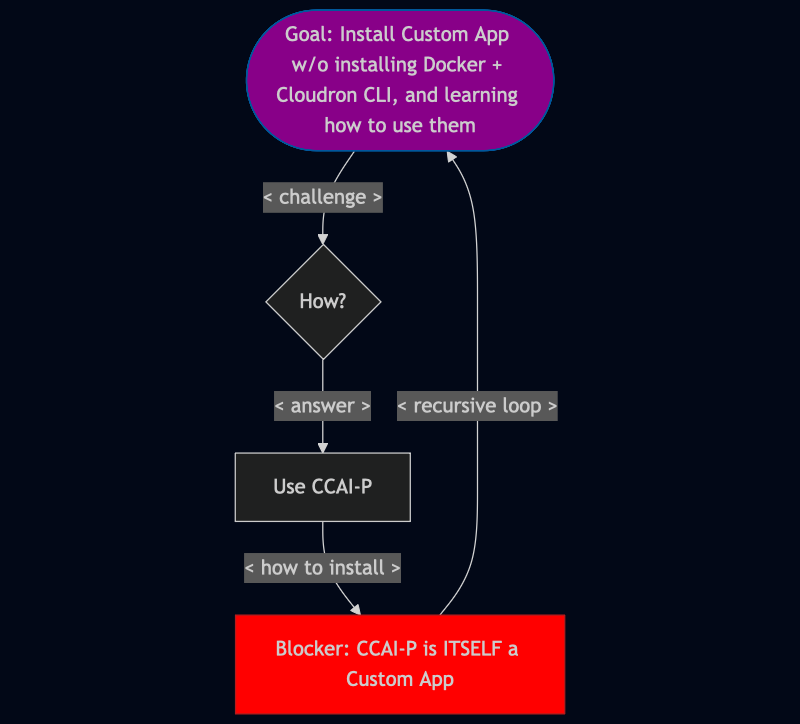
The Solution :
NEW : CustomAppGateway
-
no more technical or knowledge blocks
-
no more excuses
-
a whole new world of opportunity opened up
-
available in your preferred approach
- hosted service : zero setup
- self-hosted deployment : private setup
- binary tool : tiny run-once local setup
- security : single-use token (optionally also IP address limited to only you )
Release : 21st January 2026
Standby ....
-
-
-
[Announce] CustomAppGateway (CAG) – Solving the "Chicken & Egg" for Custom Apps
Hi everyone,
I'm excited to share a new project that I hope will be a valuable addition to our ecosystem: CustomAppGateway (CAG).
Available now at CAG Website
The "Chicken & Egg" Problem
For a while now, I've been working on CCAI and then CCAI-P (Cloudron Custom App Installer - Personal), a tool designed to be the primary "Install UI" for custom apps. It empowers you to easily install packaged custom apps that aren't yet in the official store.
However, there is a catch-22: How do you install the installer (CCAI-P) without using the CLI ?
Enter CustomAppGateway (CAG)
CustomAppGateway is the solution to that problem. It is a specialized, lightweight run-once tool designed solely to deploy CCAI-P to your Cloudron instance securely and easily.
It provides three simple methods:
- CAG Online (Hosted): A web-based installer that runs securely in your browser (using a proxy to handle CORS, with tokens processed in memory only).
- CAG Web (self-hosted) : same as above but made easy to deploy to your own server.
- CAG App (Downloaded): A standalone terminal executable for Mac, Windows, and Linux for those who prefer a local utility.
AppStore Independence
CAG and CCAI-P are about AppStore Independence. You are not reliant on waiting for an app to be officially adopted or packaged by the Cloudron team to use it, if you need it NOW.
That said, the Cloudron App Store remains vital. It provides the seamless, tested update mechanism we all rely on. While custom apps give us freedom and immediacy, the App Store is still the gold standard for long-term maintenance and stability.
Updates & Housekeeping
- CCAI-P is now the primary interface for installing custom apps and will receive further updates and improvements.
- The old CCAI open hosted version is effectively deprecated and will be archived/deleted. I encourage everyone to switch to using CCAI-P.
Security
A hot topic which I’ve taken seriously.
CAG leverages the excellent security baked into the Cloudron platform.
We focus on :- using a dedicated one-time token which you create and subsequently delete
- restricting the token to use only on your IP address
The footprint for attack is tiny.
A Note to the Cloudron Team
I want to extend a huge and ongoing thank you to the Cloudron team for their continued, tireless efforts. Cloudron remains the #1 self-hosting platform because of your hard work.
We know you face time and effort constraints with a small team. My hope is that CustomAppGateway and CCAI-P can ease your burden a little by empowering the community to self-service their custom app needs, allowing you to focus on the core platform and official apps.
Where to get it
Status
- hosted installer : zero setup : tested
- web installer : private setup : tested
- desktop installer : minimal setup : tested on MacOS
- TODO :
- test desktop installer on Windows
- test desktop installer on Linux
Feedback is always welcome!
And in doing so, please cut me some slack - it's a ground-breaking project, and as such may have some gremlins for a short (hopefully) while. -
House-keeping :
- Cloudron have announced they will introduce support "in-platform" for custom app deployments

- consequently CCAI (the open hosted-as-a-service version) can no longer be installed from CCAI. (It can be installed manually if really needed but I don't really see why anyone would want to).
- CCAI-P (the personal edition which stores auth creds locally in app) can no longer be installed from CCAI : if you want CCAI-P, use the new https://customappgateway.appx.uk distribution point
- CCAI-P has been cleaned of legacy auth timeouts (inherited from original CCAI) so runtime gremlins should not occur. There is still a manual logout and connect option, in case the user wants to do so manually. Otherwise it should remain 'ready to go' without timeouts.
Improvements :
- both CCAI and CCAI-P still focus on new installations, and there is no support for updating an existing custom app. I am working on introducing support for updates.
The Future :
- with Cloudron's announcement that their v9.1 release will include some support for in-platform deployment of custom apps, "the writing is clearly on the wall" and CCAI / CCAI-P / CustomAppGateway will die and git repos / docker images will be removed at some point.
- I doubt anyone is more pleased than me !
- however we do not know the timescales for Cloudron 9.1 (other big stuff in it too), so I will continue to make available CCAI / CCAI-P until some point after Cloudron 9.1 is stable.
- Cloudron have announced they will introduce support "in-platform" for custom app deployments




Hello! It looks like you're interested in this conversation, but you don't have an account yet.
Getting fed up of having to scroll through the same posts each visit? When you register for an account, you'll always come back to exactly where you were before, and choose to be notified of new replies (either via email, or push notification). You'll also be able to save bookmarks and upvote posts to show your appreciation to other community members.
With your input, this post could be even better 💗
Register Login