Cloudron makes it easy to run web apps like WordPress, Nextcloud, GitLab on your server. Find out more or install now.


Skip to content
  • Categories
  • Recent
  • Tags
  • Popular
  • Bookmarks
  • Search
Skins
  • Light
  • Brite
  • Cerulean
  • Cosmo
  • Flatly
  • Journal
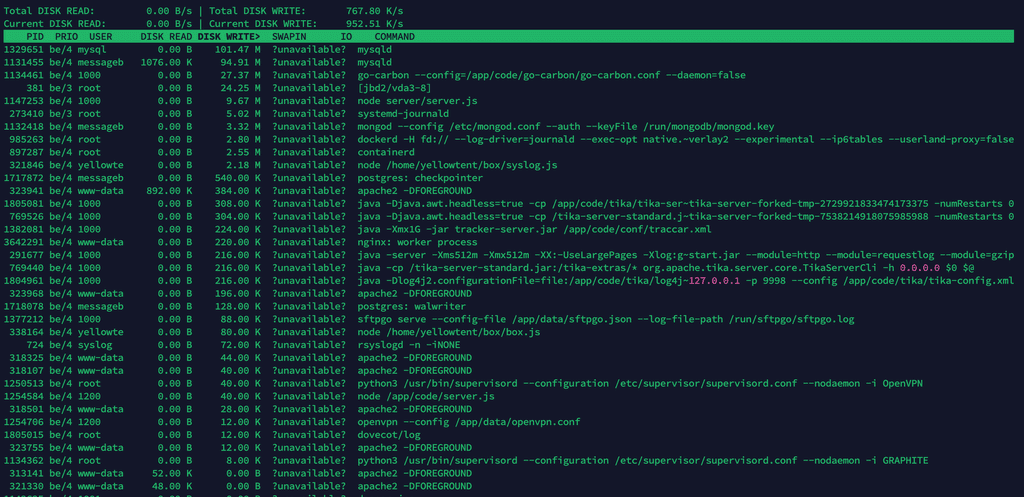
  • Litera
  • Lumen
  • Lux
  • Materia
  • Minty
  • Morph
  • Pulse
  • Sandstone
  • Simplex
  • Sketchy
  • Spacelab
  • United
  • Yeti
  • Zephyr
  • Dark
  • Cyborg
  • Darkly
  • Quartz
  • Slate
  • Solar
  • Superhero
  • Vapor

  • Default (No Skin)
  • No Skin
Collapse
Brand Logo

Cloudron Forum

Apps - Status | Demo | Docs | Install
  1. Cloudron Forum
  2. Support
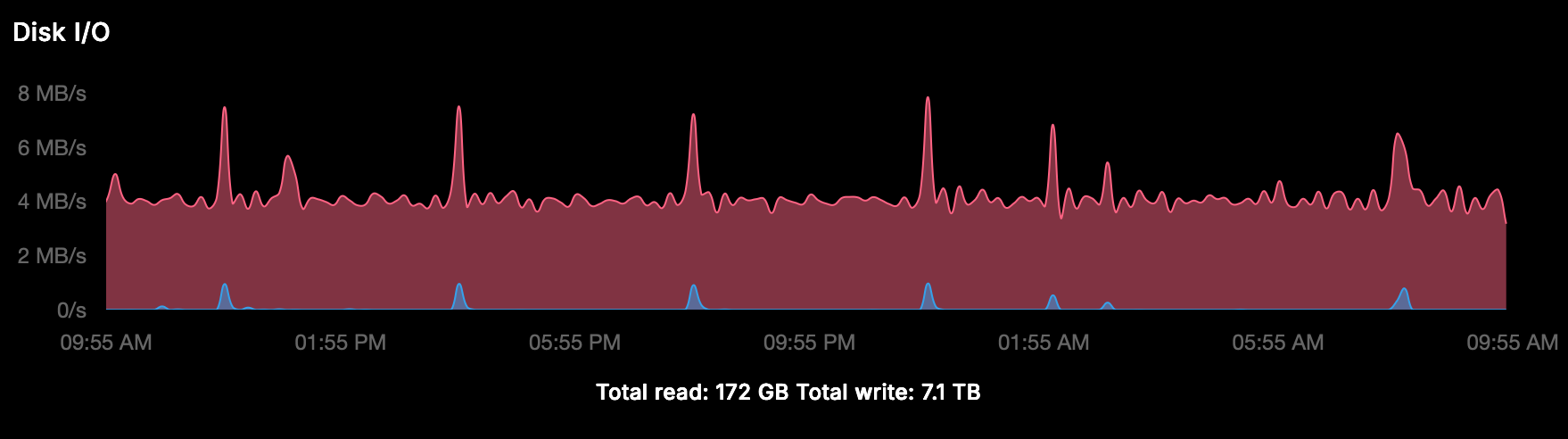
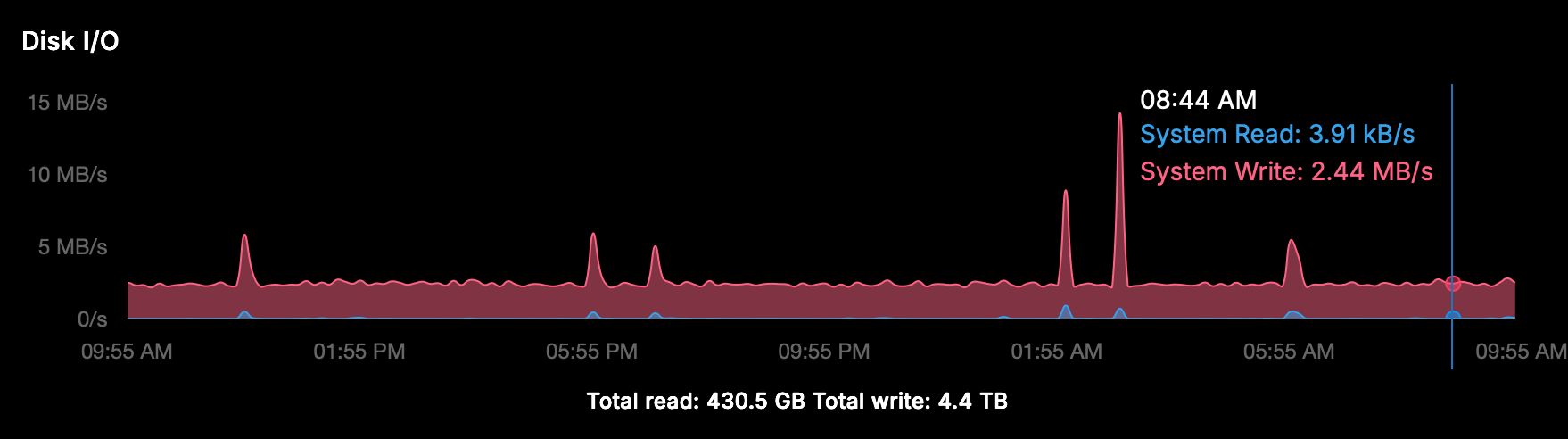
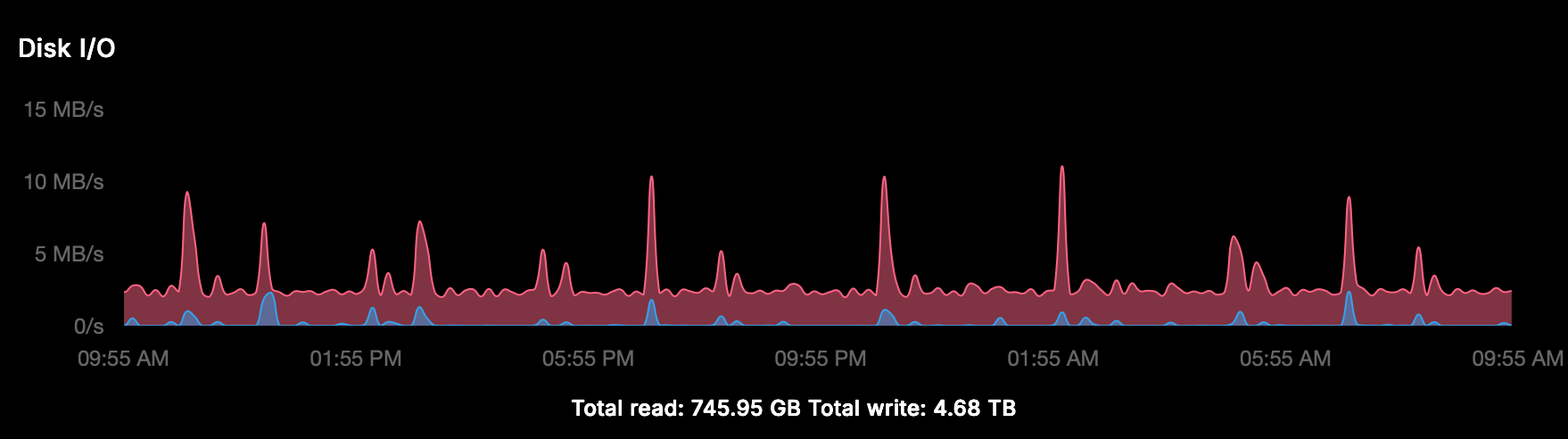
  3. Cloudron v9: huge disk I/O is this normal/safe/needed?

Cloudron v9: huge disk I/O is this normal/safe/needed?
Scheduled Pinned Locked Moved Unsolved Support
graphs
27 Posts 7 Posters 1.5k Views 7 Watching
  • Oldest to Newest
  • Newest to Oldest
  • Most Votes
Reply
  • Reply as topic
Log in to reply
This topic has been deleted. Only users with topic management privileges can see it.
  • jamesJ Offline
    jamesJ Offline
    james
    Staff
    wrote on last edited by
    #10

    Hello @imc67
    Can you run the following command:

    iotop -aoP
    

    This gives a live view of what is currently writing IO to the disk.
    Maybe this output can give some more indications where this is coming from.

    1 Reply Last reply
    0
    • imc67I Offline
      imc67I Offline
      imc67
      translator
      wrote on last edited by
      #11

      its not default installed:

      Command 'iotop' not found, but can be installed with:
      apt install iotop    # version 0.6-24-g733f3f8-1.1ubuntu0.1, or
      apt install iotop-c  # version 1.21-1
      
      1 Reply Last reply
      0
      • nebulonN Offline
        nebulonN Offline
        nebulon
        Staff
        wrote on last edited by
        #12

        yeah it is not installed by default, but you can safely install iotop via apt on your system.

        1 Reply Last reply
        0
        • imc67I Offline
          imc67I Offline
          imc67
          translator
          wrote on last edited by
          #13

          and now?

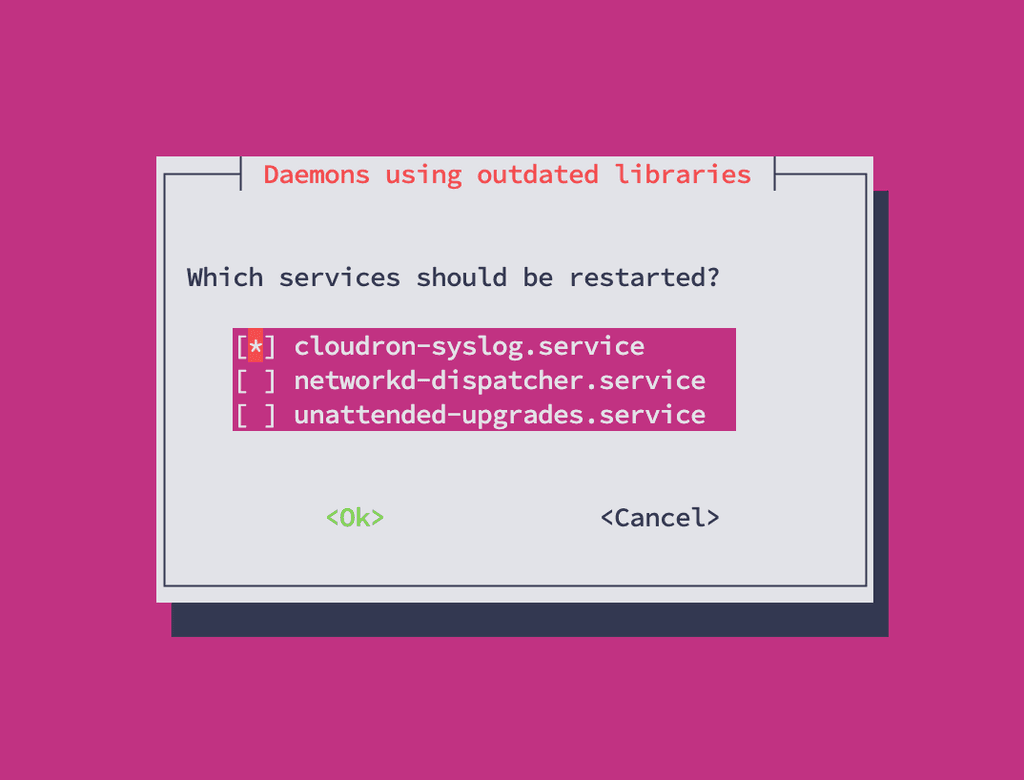
          Scherm­afbeelding 2025-12-02 om 11.44.57.png

          1 Reply Last reply
          0
          • jamesJ Offline
            jamesJ Offline
            james
            Staff
            wrote on last edited by
            #14

            Hello @imc67
            You can either deselect it or press OK, restarting services should cause no issues.

            1 Reply Last reply
            0
            • imc67I Offline
              imc67I Offline
              imc67
              translator
              wrote on last edited by
              #15

              ok thanks, below the result after just a few minutes, I'm not a technician but as far as I can see it's mainly mysql which is writing (I sorted Write):
              de0b4ce4-096f-4c6b-977b-dcf6574125ea-Scherm­afbeelding 2025-12-02 om 14.30.00.png

              1 Reply Last reply
              0
              • nebulonN Offline
                nebulonN Offline
                nebulon
                Staff
                wrote on last edited by
                #16

                Since we debugged some other issue on that server, was also taking a look at the disk I/O. So basically the mysql service is doing a lot of disk I/O (also as see in the screenshot).

                It does seem the mysql addon is just queried and written to a lot. So likely one of the many installed apps using it might commit a lot to the database. I didn't want to stop apps, but maybe you can try to stop individual apps which use mysql one-by-one to hopefully find the one which causes the constant writes.

                1 Reply Last reply
                1
                • imc67I Offline
                  imc67I Offline
                  imc67
                  translator
                  wrote on last edited by imc67
                  #17

                  Thanks @nebulon for your time, together with ChatGPT I did deeper analysis but I also read this: https://docs.cloudron.io/troubleshooting/#mysql

                  Two instances of MySQL
                  There are two instances of MySQL on Cloudron. One instance runs on the host and is used by the platform. Another instance is the MySQL addon which runs in a container named mysql and is shared by apps. This test is related to the host MySQL.
                  

                  Doesn't this mean that the mysql service in iotop is the "host version" that has nothing to do with the apps?

                  For now "we" (I) have seen this:

                  Summary of Disk Write I/O Observation on Cloudron Host

                  • Using iotop, the host shows consistently high disk write I/O (4–5 MB/s).
                  • Analysis of MySQL processes (mysqld) indicates these are responsible for the majority of the write load.
                  • The high write I/O is primarily due to InnoDB internal activity: buffer pool flushes, redo log writes, and metadata updates, mostly from the box database (eventlog, tasks, backups).

                  In about 10 minutes this is the Disk Write I/O (so 1.5GB in 10 minutes)

                  Total DISK READ:         0.00 B/s | Total DISK WRITE:         2.73 M/s
                  Current DISK READ:       0.00 B/s | Current DISK WRITE:       4.25 M/s
                      TID  PRIO  USER     DISK READ DISK WRITE>  SWAPIN      IO    COMMAND                                                                                                                  
                    21250 be/4 messageb      0.00 B   1038.50 M  ?unavailable?  mysqld
                      936 be/4 mysql         0.00 B    465.28 M  ?unavailable?  mysqld
                  

                  I stopped about 25% of the apps at a certain moment with no significant result, this is the current situation (IMHO not really intensive application and they have low traffic):

                  App 	Status 
                  Yourls	Running 
                  WordPress (Developer)	Running 
                  WordPress (Developer)	Running 
                  WordPress (Developer)	Running 
                  WordPress (Developer)	Running 
                  WordPress (Developer)	Running 
                  WordPress (Developer)	Stopped 
                  WordPress (Developer)	Running 
                  WordPress (Developer)	Stopped 
                  WordPress (Developer)	Running 
                  WordPress (Developer)	Running 
                  WordPress (Developer)	Running 
                  WordPress (Developer)	Running 
                  WordPress (Developer)	Running 
                  WordPress (Developer)	Running 
                  WordPress (Developer)	Stopped 
                  WordPress (Developer)	Running 
                  Taiga	Stopped 
                  Surfer	Running 
                  Surfer	Stopped 
                  Roundcube	Running 
                  Roundcube	Running 
                  Omeka S	Stopped 
                  Moodle	Stopped 
                  LAMP	Running 
                  Roundcube	Running 
                  Roundcube	Running 
                  Roundcube	Running 
                  Pretix	Stopped 
                  MiroTalk SFU	Running 
                  Matomo	Running 
                  FreeScout	Running 
                  FreeScout	Running 
                  Espo CRM	Running 
                  

                  What to do next to find the root cause?

                  avatar1024A 1 Reply Last reply
                  0
                  • imc67I imc67

                    Thanks @nebulon for your time, together with ChatGPT I did deeper analysis but I also read this: https://docs.cloudron.io/troubleshooting/#mysql

                    Two instances of MySQL
                    There are two instances of MySQL on Cloudron. One instance runs on the host and is used by the platform. Another instance is the MySQL addon which runs in a container named mysql and is shared by apps. This test is related to the host MySQL.
                    

                    Doesn't this mean that the mysql service in iotop is the "host version" that has nothing to do with the apps?

                    For now "we" (I) have seen this:

                    Summary of Disk Write I/O Observation on Cloudron Host

                    • Using iotop, the host shows consistently high disk write I/O (4–5 MB/s).
                    • Analysis of MySQL processes (mysqld) indicates these are responsible for the majority of the write load.
                    • The high write I/O is primarily due to InnoDB internal activity: buffer pool flushes, redo log writes, and metadata updates, mostly from the box database (eventlog, tasks, backups).

                    In about 10 minutes this is the Disk Write I/O (so 1.5GB in 10 minutes)

                    Total DISK READ:         0.00 B/s | Total DISK WRITE:         2.73 M/s
                    Current DISK READ:       0.00 B/s | Current DISK WRITE:       4.25 M/s
                        TID  PRIO  USER     DISK READ DISK WRITE>  SWAPIN      IO    COMMAND                                                                                                                  
                      21250 be/4 messageb      0.00 B   1038.50 M  ?unavailable?  mysqld
                        936 be/4 mysql         0.00 B    465.28 M  ?unavailable?  mysqld
                    

                    I stopped about 25% of the apps at a certain moment with no significant result, this is the current situation (IMHO not really intensive application and they have low traffic):

                    App 	Status 
                    Yourls	Running 
                    WordPress (Developer)	Running 
                    WordPress (Developer)	Running 
                    WordPress (Developer)	Running 
                    WordPress (Developer)	Running 
                    WordPress (Developer)	Running 
                    WordPress (Developer)	Stopped 
                    WordPress (Developer)	Running 
                    WordPress (Developer)	Stopped 
                    WordPress (Developer)	Running 
                    WordPress (Developer)	Running 
                    WordPress (Developer)	Running 
                    WordPress (Developer)	Running 
                    WordPress (Developer)	Running 
                    WordPress (Developer)	Running 
                    WordPress (Developer)	Stopped 
                    WordPress (Developer)	Running 
                    Taiga	Stopped 
                    Surfer	Running 
                    Surfer	Stopped 
                    Roundcube	Running 
                    Roundcube	Running 
                    Omeka S	Stopped 
                    Moodle	Stopped 
                    LAMP	Running 
                    Roundcube	Running 
                    Roundcube	Running 
                    Roundcube	Running 
                    Pretix	Stopped 
                    MiroTalk SFU	Running 
                    Matomo	Running 
                    FreeScout	Running 
                    FreeScout	Running 
                    Espo CRM	Running 
                    

                    What to do next to find the root cause?

                    avatar1024A Online
                    avatar1024A Online
                    avatar1024
                    wrote on last edited by
                    #18

                    @imc67 said in Cloudron v9: huge disk I/O is this normal/safe/needed?:

                    I stopped about 25% of the apps at a certain moment with no significant result

                    I think @nebulon was suggesting to stop apps one by one to see if one particular app is causing the problem.

                    1 Reply Last reply
                    1
                    • robiR Offline
                      robiR Offline
                      robi
                      wrote on last edited by
                      #19

                      Generally such system behavior is accompanied by higher CPU and Memory usage, so you can start with stopping those, and see which one causes a dip MySQL usage.

                      Conscious tech

                      1 Reply Last reply
                      0
                      • imc67I Offline
                        imc67I Offline
                        imc67
                        translator
                        wrote on last edited by imc67
                        #20

                        It’s a production server, isn’t it ridiculous to stop these apps to watch resource behavior? There must be tools or ways to find the root cause don’t you think?

                        Beside that it’s the host MySQL does it has anything to do with apps?

                        robiR 1 Reply Last reply
                        0
                        • imc67I imc67

                          It’s a production server, isn’t it ridiculous to stop these apps to watch resource behavior? There must be tools or ways to find the root cause don’t you think?

                          Beside that it’s the host MySQL does it has anything to do with apps?

                          robiR Offline
                          robiR Offline
                          robi
                          wrote on last edited by
                          #21

                          @imc67 Holding that limiting belief is keeping your problem unresolved, no?

                          Sure, then trace it from the MySQL side, find which user, which container and so on..

                          Yes, it has everything to do with the Apps that are using that DB instance.

                          Conscious tech

                          1 Reply Last reply
                          0
                          • jamesJ Offline
                            jamesJ Offline
                            james
                            Staff
                            wrote on last edited by
                            #22

                            Hello @imc67
                            You can use the PID from the process to figure out what mysql service it is.

                            e.g. your iotop shows for mysqld the pid 1994756.
                            You can run systemctl status mysql.service and there is the pid displayed:

                            ● mysql.service - MySQL Community Server
                                 Loaded: loaded (/usr/lib/systemd/system/mysql.service; enabled; preset: enabled)
                                 Active: active (running) since Mon 2025-12-01 09:17:59 UTC; 1 week 5 days ago
                               Main PID: 1994756 (mysqld)
                                 Status: "Server is operational"
                                  Tasks: 48 (limit: 4603)
                                 Memory: 178.7M (peak: 298.0M swap: 95.4M swap peak: 108.7M)
                                    CPU: 1h 41min 31.520s
                                 CGroup: /system.slice/mysql.service
                                         └─1994756 /usr/sbin/mysqld
                            
                            Notice: journal has been rotated since unit was started, output may be incomplete.
                            

                            So from iotop I can confirm that the system mysqld service is pid 1994756 so I'd know to inspect the system mysqld service and not the docker mysql service.

                            You can also get the pid from the mysqld inside the docker container with docker top mysql:

                            docker top mysql
                            UID                 PID                 PPID                C                   STIME               TTY                 TIME                CMD
                            root                1889                1512                0                   Nov07               ?                   00:06:17            /usr/bin/python3 /usr/bin/supervisord --configuration /etc/supervisor/supervisord.conf --nodaemon -i Mysql
                            usbmux              3079                1889                0                   Nov07               ?                   03:49:38            /usr/sbin/mysqld
                            usbmux              3099                1889                0                   Nov07               ?                   00:00:11            node /app/code/service.js
                            

                            Then I know the mysqld pid of the docker service is 3079 which I can check again with the system:

                            ps uax | grep -i 3079
                            usbmux      3079  0.4  1.0 1587720 43692 ?       Sl   Nov07 229:38 /usr/sbin/mysqld
                            

                            Now we can differentiate between the two.


                            Okay.
                            Now that we can differentiate between the two, you can observe iotop and see which one has a high I/O.
                            After you narrow it down to either one, then we can do some analysis what database / table get accesses the most even further narrow it down.

                            1 Reply Last reply
                            2
                            • imc67I Offline
                              imc67I Offline
                              imc67
                              translator
                              wrote on last edited by
                              #23

                              Ok, thanks for your hints!!

                              The result was PID 19974

                              However:

                              ● mysql.service - MySQL Community Server
                                   Loaded: loaded (/lib/systemd/system/mysql.service; enabled; vendor preset: enabled)
                                   Active: active (running) since Sat 2025-12-13 05:57:30 UTC; 1 day 5h ago
                                  Process: 874 ExecStartPre=/usr/share/mysql/mysql-systemd-start pre (code=exited, status=0/SUCCESS)
                                 Main PID: 910 (mysqld)
                                   Status: "Server is operational"
                                    Tasks: 47 (limit: 77023)
                                   Memory: 601.7M
                                      CPU: 59min 14.538s
                                   CGroup: /system.slice/mysql.service
                                           └─910 /usr/sbin/mysqld
                              

                              And docker top mysql

                              UID                 PID                 PPID                C                   STIME               TTY                 TIME                CMD
                              root                9842                8908                0                   Dec13               ?                   00:00:17            /usr/bin/python3 /usr/bin/supervisord --configuration /etc/supervisor/supervisord.conf --nodaemon -i Mysql
                              message+            19974               9842                6                   Dec13               ?                   01:56:43            /usr/sbin/mysqld
                              message+            19976               9842                0                   Dec13               ?                   00:01:31            node /app/code/service.js
                              

                              So ps uax | grep -i 19974 gives:

                              message+   19974  6.6  1.8 4249604 1229136 ?     Sl   Dec13 116:48 /usr/sbin/mysqld
                              

                              So at least we now know that it's the Docker MySQL

                              1 Reply Last reply
                              0
                              • jamesJ Offline
                                jamesJ Offline
                                james
                                Staff
                                wrote on last edited by
                                #24

                                Hello @imc67
                                Now we can start analysing.
                                Edit the file /home/yellowtent/platformdata/mysql/custom.cnf and add the following lines:

                                [mysqld]
                                general_log = 1
                                slow_query_log = 1
                                

                                Restart the MySQL service in the Cloudron Dashboard.
                                The log files are stored at /home/yellowtent/platformdata/mysql/mysql.log and /home/yellowtent/platformdata/mysql/mysql-slow.log.

                                Let it run for a day or more.
                                Then you can download the log files and see what queries run very often causing disk I/O.

                                1 Reply Last reply
                                3
                                • imc67I Offline
                                  imc67I Offline
                                  imc67
                                  translator
                                  wrote on last edited by
                                  #25

                                  I enabled this en within seconds the log file was enormous, I asked ChatGPT to analyse it and here is it's observations: (too technical for me):


                                  Some observations after briefly enabling the MySQL general log (Cloudron v9)

                                  I enabled the MySQL general log only for a short time because of disk I/O concerns, but even within a few minutes a clear pattern showed up.

                                  What I’m seeing:

                                  • A very high number of
                                    INSERT INTO session (...) and
                                    INSERT ... ON DUPLICATE KEY UPDATE
                                  • These happen continuously and come from 172.18.0.1
                                  • As far as I understand, this IP is the Docker bridge gateway in Cloudron, so it likely represents multiple apps

                                  I temporarily disabled Matomo to rule that out, but disk I/O and session-related writes did not noticeably decrease, so it does not seem to be the main contributor.

                                  From the log it looks like:

                                  • Multiple applications are storing sessions in MySQL
                                  • Session rows are updated on almost every request
                                  • This can generate a lot of InnoDB redo log and disk I/O, even with low traffic

                                  Nothing looks obviously broken, but I’m trying to understand whether this level of session write activity is:

                                  • expected behavior in Cloudron v9
                                  • something that can be tuned or configured
                                  • or if there are recommended best practices (e.g. Redis for sessions)

                                  Any guidance on how Cloudron expects apps to handle sessions, or how to reduce unnecessary MySQL write I/O, would be much appreciated.

                                  Thanks for looking into this.

                                  1 Reply Last reply
                                  0
                                  • J Online
                                    J Online
                                    joseph
                                    Staff
                                    wrote on last edited by
                                    #26

                                    Do you have happen to use nextcloud on the server? I think nextcloud+ldap keeps doing a login request when syncing for each file (which might trigger a login eventlog in mysql)

                                    imc67I 1 Reply Last reply
                                    0
                                    • J joseph

                                      Do you have happen to use nextcloud on the server? I think nextcloud+ldap keeps doing a login request when syncing for each file (which might trigger a login eventlog in mysql)

                                      imc67I Offline
                                      imc67I Offline
                                      imc67
                                      translator
                                      wrote on last edited by
                                      #27

                                      @joseph said in Cloudron v9: huge disk I/O is this normal/safe/needed?:

                                      Do you have happen to use nextcloud on the server? I think nextcloud+ldap keeps doing a login request when syncing for each file (which might trigger a login eventlog in mysql)

                                      No there is no Nextcloud on this server

                                      1 Reply Last reply
                                      0
                                      Reply
                                      • Reply as topic
                                      Log in to reply
                                      • Oldest to Newest
                                      • Newest to Oldest
                                      • Most Votes


                                      • Login

                                      • Don't have an account? Register

                                      • Login or register to search.
                                      • First post
                                        Last post
                                      0
                                      • Categories
                                      • Recent
                                      • Tags
                                      • Popular
                                      • Bookmarks
                                      • Search