
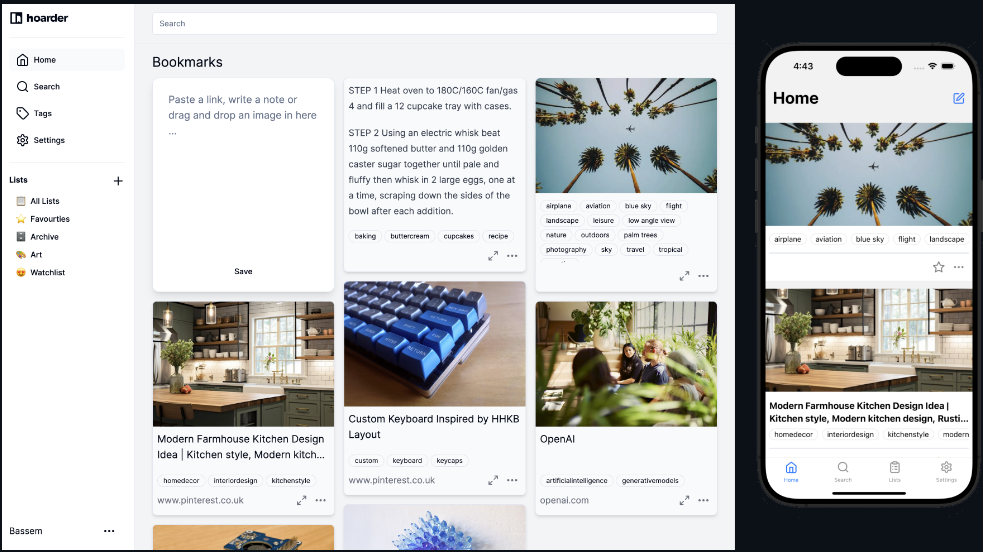
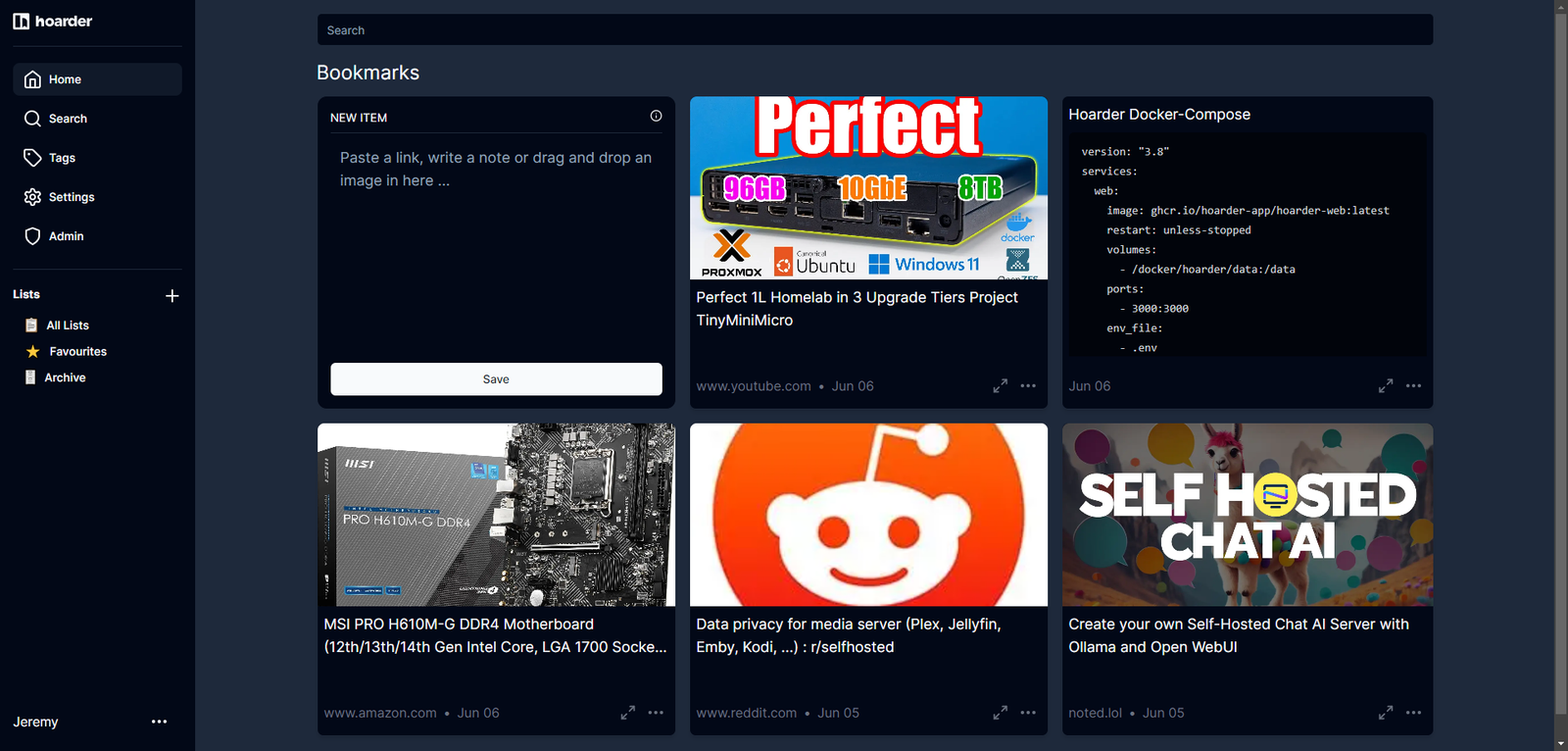
Hoarder (Now, Karakeep) - Mymind alternative - The Ultimate All-In-One Bookmark and Note Taking App
-
I have also tested it on Pikapods right now, and I can say it's better than the current alternatives on Cloudron. I would even suggest that the current apps that do something similar on Cloudron could be discontinued to support this, which seems to be by far better.
-
@scooke You don't need Open AI or any AI to tag. It's just optional.
-
it has changed its name to (I assume) deal with the patent issues
https://docs.karakeep.app/administration/hoarder-to-karakeep-migration/ -
@robi Yes! Or use a service with an "OpenAI compatible" API, e.g. https://gab.ai
In any case, please add me to this growing list of "we want Karakeep" people. Thank you to @jagan too for so wholeheartedly recommending this application.
I remember when somebody got me onto Shaarli! I was delighted. Then @timeconsidine tuned me onto Linkwarden, which was a bit more advanced. Hearing @jagan raving about how it helps tidy up your notes, well, I just want to try this.
I hope we support it soon.
-
With linkding possibly abandoned (see https://github.com/sissbruecker/linkding/issues/1367), Karakeep would be a strong contestant for an app release!
Singlefile is now built-in as well. -
With linkding possibly abandoned (see https://github.com/sissbruecker/linkding/issues/1367), Karakeep would be a strong contestant for an app release!
Singlefile is now built-in as well.With linkding possibly abandoned (see https://github.com/sissbruecker/linkding/issues/1367)

-
One nice feature about https://karakeep.app/ is that it automatically tags your bookmarks for you. This can be very handy if you are trying to rapidly research several new sites. It can also help keep your tags better organized.
I hope we support karakeep.
I am still quite a way behind everybody else. I still have fond memories of how much Shaarli helped and am just getting used to the warm glow of using linkwarden.
 ️ Bookmark importers from Chrome, Pocket, Linkwarden, Omnivore, Tab Session Manager.
 -
This whole forum will rain down on me if we release another notes/link/bookmark app

Maybe we can revisit this as Linkding‘s author still seems to be MIA (https://github.com/sissbruecker/linkding/issues/1367)….
-
@necrevistonnezr @loudlemur @jagan @scooke @jdaviescoates @gregy @swheeler78 @ekevu123
I packaged this for now. But I'm honestly a bit underwhelmed by it.Was hoping it would be more useful as a note taking app, but it's practically only for bookmarks. https://ca.cloudron.io/app/karakeep
-
@necrevistonnezr @loudlemur @jagan @scooke @jdaviescoates @gregy @swheeler78 @ekevu123
I packaged this for now. But I'm honestly a bit underwhelmed by it.Was hoping it would be more useful as a note taking app, but it's practically only for bookmarks. https://ca.cloudron.io/app/karakeep
@andreasdueren looks nice though
good job, thank you -
Thank you very much!
-
Can this keep track of browsing history or only booked bookmarks?
I'd love to reduce the many tabs I have, if they would be searchable later.
@robi I use OneTab for that, although I don't think it searches within the pages.
-
@robi I use OneTab for that, although I don't think it searches within the pages.
@jdaviescoates Thanks for the reminder.. I used to use it a long time ago.
Installed it, had 860+ tabs to organize.
I just wish it would restore tab groups in sleep state instead of loading them all at once.
-
@jdaviescoates Thanks for the reminder.. I used to use it a long time ago.
Installed it, had 860+ tabs to organize.
I just wish it would restore tab groups in sleep state instead of loading them all at once.
@robi There used to be a nice browser extension called colourful tabs. It assigned colours to your tabs and would remember them across sessions.
One cool feature was it had categories, so for example, you could setup a news category and then all your news site tabs would be that colour, but your hacking sites would appear differerently.
One feature that would be nice would be to have a throbbing tab if it were playing audio. Sometimes it is hard to find where the sound is.
-
@robi There used to be a nice browser extension called colourful tabs. It assigned colours to your tabs and would remember them across sessions.
One cool feature was it had categories, so for example, you could setup a news category and then all your news site tabs would be that colour, but your hacking sites would appear differerently.
One feature that would be nice would be to have a throbbing tab if it were playing audio. Sometimes it is hard to find where the sound is.
@LoudLemur I just want most of my tabs to unload their memory and sleep while I use the active window full of research and current activities.
-
@necrevistonnezr @loudlemur @jagan @scooke @jdaviescoates @gregy @swheeler78 @ekevu123
I packaged this for now. But I'm honestly a bit underwhelmed by it.Was hoping it would be more useful as a note taking app, but it's practically only for bookmarks. https://ca.cloudron.io/app/karakeep
Thank you for packaging this, and congratulations on getting it out. Karakeep has been sitting on the wishlist since June 2024 and it is good to finally see it on the store.
I should explain why I am replying at such length. We were part way through scoping our own Karakeep package when we found yours. Separately, we have just finished packaging Meilisearch standalone for Cloudron and put it through a full acceptance ladder on a real rig, which means we spent an unreasonable number of hours on exactly the one component your package bundles. What follows is what that cost us, offered in the hope it saves you the same. Almost all of it is about the Meilisearch leg.
Some of this is measured on our own package and some of it is inference about yours that we have not tested. I have tried to be explicit about which is which throughout, because I do not want to report a defect we have not actually reproduced.
First, the things that are plainly right, because I read the whole tree and it would be rude not to say so. The secret handling in
start.shis properly idempotent: generated once, gated on non-emptiness, umask 077, atomic write through a temporary file, and the mode re-asserted on every boot rather than only on first run. That last detail is the one most packages get wrong, and a restore resets modes, so it matters. Running the migrations synchronously before supervisord so the port opens only once they are done is the right call. The OIDC redirect URI is/api/auth/callback/custom, which is the correct provider-id-derived path and not the intuitive wrong one. The scheduled CI that polls upstream releases and bumps the pin is better release machinery than most community packages have, including ours. And binding Meilisearch and Chromium to loopback is exactly right.The Meilisearch store and backups
This is the substantive one, and it has two parts that are worth separating because they have different levels of confidence.
The part I am confident about: a live LMDB store copied file by file is not a restorable artefact.
Your Meilisearch runs with
--db-path /app/data/meilisearch, which puts the live store inside the tree Cloudron copies. The platform takes that copy while the application is running, with no quiesce step and no post-backup hook. For a key file or a SQLite database at rest that is fine. For an LMDB store that is being written to, the copy has no defined consistency point, and Meilisearch does not consider a raw file copy restorable; a snapshot is what it considers restorable. So the index inside your backups may or may not come back cleanly, and nothing currently tells the operator which.The saving grace specific to Karakeep is that the index is derivable: Karakeep can rebuild it from SQLite through the admin "Reindex All Bookmarks" action. That turns a potentially corrupt restore from data loss into an inconvenience, which is a much better position than most applications are in. But it only works if the operator knows to do it, and at the moment
POSTINSTALL.mddoes not mention it. The cheapest possible fix here is one paragraph of documentation saying that after a restore, search may be empty or stale until a reindex is run. That costs you nothing and closes the worst outcome.The part I am not confident about: whether this can abort the backup run itself.
Cloudron's rsync syncer walks
/app/dataand is not resilient to concurrent mutation. Its tree walk lists a directory then recurses into it, and if a child directory disappears between the list and the recurse, the read returns null and a later sort throws. The exception is not caught per application. It aborts the entire server's backup run, so one application's temp-directory churn becomes every application's missed backup.I want to be careful here. That failure was earned against ClickHouse, whose merge process creates and atomically renames temporary directories continuously, and it generalises cleanly to Elasticsearch and RocksDB. Meilisearch is a much narrower case: mostly long-lived files under
indexes/<uuid>/, and the obvious candidates for a vanishing directory are an index deletion landing mid-backup, or churn in the dump and snapshot directories. We have not reproduced this against Meilisearch, and we have not tested your package at all. Our own package moved the store out of the walked tree from the start, so we never ran the experiment that would have proved it either way. Treat it as a live question rather than a finding.If you want to settle it, the test is cheap: put a decent corpus in, start a large indexing batch, delete an index while it runs, and trigger a backup from the dashboard during the churn. Either the run completes or you get a syncer stack trace in the box logs. (It is cheap, but it does take a long time, especially if your server is busy!)
The design that solves both parts, if you want it.
minBoxVersionin your manifest is already 9.1.0, which is the version that unlocks the machinery, so this is available to you today. Move the live store onto apersistentDirspath outside/app/data, and add abackupCommandthat asks the running instance for a snapshot over its own HTTP API and drops the artefact into/app/datafor the platform to pick up.The one non-obvious part is that
backupCommandruns in a temporary container, not the live one: noCLOUDRON_*environment variables, stdout discarded, read-only root filesystem, but attached to the cloudron network with/app/dataand the persistent dirs mounted. So the backup script cannot learn its own application's address from the environment. The trick that makes it work is having the entrypoint write the container's address into a file under/app/dataon every boot, which the backup script then reads over the shared mount and dials. Ours also exits 0 on every path deliberately, including failure, because a non-zero exit from a backup command takes the platform's whole backup run down, which is worse than a snapshot that is one cycle stale. It records success or failure to a log file under/app/datainstead, since its stdout goes nowhere.We tested this under load and the result was better than we expected. A backup issued with sixteen tasks queued and
isIndexingtrue completed cleanly in 314 seconds, and the snapshot did not merely capture a consistent view: it carried the pending write queue with it, so the restored instance resumed the indexing work that was in flight. Nothing accepted before the consistency point was dropped or half indexed.Three
persistentDirsbehaviours we confirmed on a real box, since they decide what your boot logic has to handle: an update preserves the directory, an in-place restore preserves it, and a clone starts it empty. That last one is the one that bites, because it means a cloned application must be able to rebuild its store from the snapshot in/app/dataon first boot. In your case there is a second option, which is to let it rebuild from SQLite instead.The scripts are MIT licensed and public at https://github.com/OrcVole/meilisearch-cloudron if any of it is useful. Please lift whatever you want, no attribution needed.
Memory sizing
Your
memoryLimitis 2 GiB shared between Next.js, the workers, Chromium and Meilisearch, with no absolute cap on any of them.Our package gives Meilisearch 4 GiB on its own, and it needs it. At 2 GiB it failed our memory gate outright: anonymous demand alone reached about 2.5 GiB against the 2 GiB limit while indexing a million documents.
I want to be honest that this number does not transfer directly. A million documents is a far larger corpus than a typical bookmark collection, and your four processes will not all peak together in normal use. So this is not me telling you to ship 4 GiB.
What does transfer is how to read the numbers, and this is the part I would genuinely have wanted to know earlier.
memory.peakin the cgroup is useless for sizing a memory-mapped store. It sat at 100.0001 per cent of the limit in every one of our runs, at 2 GiB and at 4 GiB alike, because it counts page cache, and a store using mmap will use every page you give it and then reclaim. Reading that figure suggests a container in permanent distress when it is doing exactly what it should. The figure that means something ismemory.stat anonplus swap: at 4 GiB that peaked at 1.74 GiB, or 43.5 per cent, which is a healthy result and the one the gate should have been testing all along.Also worth knowing:
MEILI_MAX_INDEXING_MEMORYis not a ceiling on the process. It caps one specific arena. Ours was set to a third of the cgroup limit and the process still went well past it. Do not treat it as a safety bound. And Meilisearch sizes its defaults from host RAM rather than the cgroup limit, which is upstream issue 4686, so on a Cloudron box it will guess based on the whole machine unless you compute the value from/sys/fs/cgroup/memory.maxyourself at boot.The Meilisearch version bump
Your Meilisearch pin at v1.41.0 is manual and outside the CI that tracks Karakeep, so this may be some way off, but it is a trap worth knowing about before you hit it.
Meilisearch will refuse to start against a store written by an older version. Handling it needs an explicit upgrade path: record the version that wrote the store in a marker file, compare it at boot, and run the upgrade when they differ. The rollback direction matters too, because a store written by a newer binary than the one now running cannot simply be opened, and that is exactly what a Cloudron rollback to a previous package version produces.
Separately, 1.51.0 removed several flags that earlier versions accepted, including
--experimental-no-snapshot-compaction,--experimental-replication-parametersand--experimental-no-edition-2024-for-dumps, and renamed the experimental spelling of the dumpless upgrade flag. You do not pass any of those today, so this only matters if you add one from an old blog post.Smaller things
localstorageis declared as{}with nosqliteoption, whilestart.shsetsDB_WAL_MODE=true. The addon'ssqliteoption exists to declare database paths so the backup captures them consistently, and a WAL-mode database is three files that need to agree with each other. I will be straight that our own doctrine has not settled what that option actually guarantees across the database, the WAL and the shared-memory file, so I am flagging it as worth a look rather than asserting it is broken.Supervisor priorities give you spawn order but not readiness. The web process and the workers can start talking to Meilisearch before it is accepting connections, and a worker that fails its initial connect can sit there doing nothing without saying so. A bounded wait on the dependency, sixty seconds or so, then proceeding degraded, is usually enough.
OAUTH_ALLOW_DANGEROUS_EMAIL_ACCOUNT_LINKING=trueis set unconditionally. That silently links an OIDC identity to any existing local account with a matching email address, which is a reasonable convenience on a single-operator install and a real account-takeover path on a box where users can register with an email they do not control. GivenDISABLE_SIGNUPSis left to the operator, both configurations exist in the wild. It may be worth making it opt-in through the env file, or at least calling it out inPOSTINSTALL.md.OAUTH_WELLKNOWN_URLis hand-built fromCLOUDRON_OIDC_ISSUER. Cloudron injectsCLOUDRON_OIDC_DISCOVERY_URLdirectly, so using it removes an assumption about the issuer's URL shape.Finally, and this one is a preference rather than a defect: the final stage is the upstream Karakeep image with supervisor and Chromium layered on, rather than
cloudron/base. The documented reason to prefer the base image is that the dashboard file manager, web terminal and log viewer depend on its userland. I do not know whether they actually break on a Debian-derived image, and I would be interested to hear if you have checked, because that is a question we would like answered for our own purposes too and I have not found it written down anywhere.Thanks again for the package, and apologies for the wall of text. Happy to expand on any of it, and happier still to be told I am wrong about the parts I have flagged as untested.
-
Thank you for packaging this, and congratulations on getting it out. Karakeep has been sitting on the wishlist since June 2024 and it is good to finally see it on the store.
I should explain why I am replying at such length. We were part way through scoping our own Karakeep package when we found yours. Separately, we have just finished packaging Meilisearch standalone for Cloudron and put it through a full acceptance ladder on a real rig, which means we spent an unreasonable number of hours on exactly the one component your package bundles. What follows is what that cost us, offered in the hope it saves you the same. Almost all of it is about the Meilisearch leg.
Some of this is measured on our own package and some of it is inference about yours that we have not tested. I have tried to be explicit about which is which throughout, because I do not want to report a defect we have not actually reproduced.
First, the things that are plainly right, because I read the whole tree and it would be rude not to say so. The secret handling in
start.shis properly idempotent: generated once, gated on non-emptiness, umask 077, atomic write through a temporary file, and the mode re-asserted on every boot rather than only on first run. That last detail is the one most packages get wrong, and a restore resets modes, so it matters. Running the migrations synchronously before supervisord so the port opens only once they are done is the right call. The OIDC redirect URI is/api/auth/callback/custom, which is the correct provider-id-derived path and not the intuitive wrong one. The scheduled CI that polls upstream releases and bumps the pin is better release machinery than most community packages have, including ours. And binding Meilisearch and Chromium to loopback is exactly right.The Meilisearch store and backups
This is the substantive one, and it has two parts that are worth separating because they have different levels of confidence.
The part I am confident about: a live LMDB store copied file by file is not a restorable artefact.
Your Meilisearch runs with
--db-path /app/data/meilisearch, which puts the live store inside the tree Cloudron copies. The platform takes that copy while the application is running, with no quiesce step and no post-backup hook. For a key file or a SQLite database at rest that is fine. For an LMDB store that is being written to, the copy has no defined consistency point, and Meilisearch does not consider a raw file copy restorable; a snapshot is what it considers restorable. So the index inside your backups may or may not come back cleanly, and nothing currently tells the operator which.The saving grace specific to Karakeep is that the index is derivable: Karakeep can rebuild it from SQLite through the admin "Reindex All Bookmarks" action. That turns a potentially corrupt restore from data loss into an inconvenience, which is a much better position than most applications are in. But it only works if the operator knows to do it, and at the moment
POSTINSTALL.mddoes not mention it. The cheapest possible fix here is one paragraph of documentation saying that after a restore, search may be empty or stale until a reindex is run. That costs you nothing and closes the worst outcome.The part I am not confident about: whether this can abort the backup run itself.
Cloudron's rsync syncer walks
/app/dataand is not resilient to concurrent mutation. Its tree walk lists a directory then recurses into it, and if a child directory disappears between the list and the recurse, the read returns null and a later sort throws. The exception is not caught per application. It aborts the entire server's backup run, so one application's temp-directory churn becomes every application's missed backup.I want to be careful here. That failure was earned against ClickHouse, whose merge process creates and atomically renames temporary directories continuously, and it generalises cleanly to Elasticsearch and RocksDB. Meilisearch is a much narrower case: mostly long-lived files under
indexes/<uuid>/, and the obvious candidates for a vanishing directory are an index deletion landing mid-backup, or churn in the dump and snapshot directories. We have not reproduced this against Meilisearch, and we have not tested your package at all. Our own package moved the store out of the walked tree from the start, so we never ran the experiment that would have proved it either way. Treat it as a live question rather than a finding.If you want to settle it, the test is cheap: put a decent corpus in, start a large indexing batch, delete an index while it runs, and trigger a backup from the dashboard during the churn. Either the run completes or you get a syncer stack trace in the box logs. (It is cheap, but it does take a long time, especially if your server is busy!)
The design that solves both parts, if you want it.
minBoxVersionin your manifest is already 9.1.0, which is the version that unlocks the machinery, so this is available to you today. Move the live store onto apersistentDirspath outside/app/data, and add abackupCommandthat asks the running instance for a snapshot over its own HTTP API and drops the artefact into/app/datafor the platform to pick up.The one non-obvious part is that
backupCommandruns in a temporary container, not the live one: noCLOUDRON_*environment variables, stdout discarded, read-only root filesystem, but attached to the cloudron network with/app/dataand the persistent dirs mounted. So the backup script cannot learn its own application's address from the environment. The trick that makes it work is having the entrypoint write the container's address into a file under/app/dataon every boot, which the backup script then reads over the shared mount and dials. Ours also exits 0 on every path deliberately, including failure, because a non-zero exit from a backup command takes the platform's whole backup run down, which is worse than a snapshot that is one cycle stale. It records success or failure to a log file under/app/datainstead, since its stdout goes nowhere.We tested this under load and the result was better than we expected. A backup issued with sixteen tasks queued and
isIndexingtrue completed cleanly in 314 seconds, and the snapshot did not merely capture a consistent view: it carried the pending write queue with it, so the restored instance resumed the indexing work that was in flight. Nothing accepted before the consistency point was dropped or half indexed.Three
persistentDirsbehaviours we confirmed on a real box, since they decide what your boot logic has to handle: an update preserves the directory, an in-place restore preserves it, and a clone starts it empty. That last one is the one that bites, because it means a cloned application must be able to rebuild its store from the snapshot in/app/dataon first boot. In your case there is a second option, which is to let it rebuild from SQLite instead.The scripts are MIT licensed and public at https://github.com/OrcVole/meilisearch-cloudron if any of it is useful. Please lift whatever you want, no attribution needed.
Memory sizing
Your
memoryLimitis 2 GiB shared between Next.js, the workers, Chromium and Meilisearch, with no absolute cap on any of them.Our package gives Meilisearch 4 GiB on its own, and it needs it. At 2 GiB it failed our memory gate outright: anonymous demand alone reached about 2.5 GiB against the 2 GiB limit while indexing a million documents.
I want to be honest that this number does not transfer directly. A million documents is a far larger corpus than a typical bookmark collection, and your four processes will not all peak together in normal use. So this is not me telling you to ship 4 GiB.
What does transfer is how to read the numbers, and this is the part I would genuinely have wanted to know earlier.
memory.peakin the cgroup is useless for sizing a memory-mapped store. It sat at 100.0001 per cent of the limit in every one of our runs, at 2 GiB and at 4 GiB alike, because it counts page cache, and a store using mmap will use every page you give it and then reclaim. Reading that figure suggests a container in permanent distress when it is doing exactly what it should. The figure that means something ismemory.stat anonplus swap: at 4 GiB that peaked at 1.74 GiB, or 43.5 per cent, which is a healthy result and the one the gate should have been testing all along.Also worth knowing:
MEILI_MAX_INDEXING_MEMORYis not a ceiling on the process. It caps one specific arena. Ours was set to a third of the cgroup limit and the process still went well past it. Do not treat it as a safety bound. And Meilisearch sizes its defaults from host RAM rather than the cgroup limit, which is upstream issue 4686, so on a Cloudron box it will guess based on the whole machine unless you compute the value from/sys/fs/cgroup/memory.maxyourself at boot.The Meilisearch version bump
Your Meilisearch pin at v1.41.0 is manual and outside the CI that tracks Karakeep, so this may be some way off, but it is a trap worth knowing about before you hit it.
Meilisearch will refuse to start against a store written by an older version. Handling it needs an explicit upgrade path: record the version that wrote the store in a marker file, compare it at boot, and run the upgrade when they differ. The rollback direction matters too, because a store written by a newer binary than the one now running cannot simply be opened, and that is exactly what a Cloudron rollback to a previous package version produces.
Separately, 1.51.0 removed several flags that earlier versions accepted, including
--experimental-no-snapshot-compaction,--experimental-replication-parametersand--experimental-no-edition-2024-for-dumps, and renamed the experimental spelling of the dumpless upgrade flag. You do not pass any of those today, so this only matters if you add one from an old blog post.Smaller things
localstorageis declared as{}with nosqliteoption, whilestart.shsetsDB_WAL_MODE=true. The addon'ssqliteoption exists to declare database paths so the backup captures them consistently, and a WAL-mode database is three files that need to agree with each other. I will be straight that our own doctrine has not settled what that option actually guarantees across the database, the WAL and the shared-memory file, so I am flagging it as worth a look rather than asserting it is broken.Supervisor priorities give you spawn order but not readiness. The web process and the workers can start talking to Meilisearch before it is accepting connections, and a worker that fails its initial connect can sit there doing nothing without saying so. A bounded wait on the dependency, sixty seconds or so, then proceeding degraded, is usually enough.
OAUTH_ALLOW_DANGEROUS_EMAIL_ACCOUNT_LINKING=trueis set unconditionally. That silently links an OIDC identity to any existing local account with a matching email address, which is a reasonable convenience on a single-operator install and a real account-takeover path on a box where users can register with an email they do not control. GivenDISABLE_SIGNUPSis left to the operator, both configurations exist in the wild. It may be worth making it opt-in through the env file, or at least calling it out inPOSTINSTALL.md.OAUTH_WELLKNOWN_URLis hand-built fromCLOUDRON_OIDC_ISSUER. Cloudron injectsCLOUDRON_OIDC_DISCOVERY_URLdirectly, so using it removes an assumption about the issuer's URL shape.Finally, and this one is a preference rather than a defect: the final stage is the upstream Karakeep image with supervisor and Chromium layered on, rather than
cloudron/base. The documented reason to prefer the base image is that the dashboard file manager, web terminal and log viewer depend on its userland. I do not know whether they actually break on a Debian-derived image, and I would be interested to hear if you have checked, because that is a question we would like answered for our own purposes too and I have not found it written down anywhere.Thanks again for the package, and apologies for the wall of text. Happy to expand on any of it, and happier still to be told I am wrong about the parts I have flagged as untested.
@LoudLemur Thanks, useful pointers. Shipped in 0.1.8:
Meilisearch version bump: this was the real one. I reproduced it, a 1.40.0 store against the 1.41.0 binary refuses to open. start.sh now compares the store VERSION against the binary, passes
--experimental-dumpless-upgradewhen the store is older, and archives the store when it is newer, which is what a package rollback produces. Comparison uses sort-V, since string compare gets1.9.0against1.41.0backwards. Both paths tested on a live box.OAUTH_ALLOW_DANGEROUS_EMAIL_ACCOUNT_LINKINGnow defaults to false and is opt-in from the env file.Switched to
CLOUDRON_OIDC_DISCOVERY_URL.POSTINSTALLnow documents that search may be stale after a restore and that Reindex All Bookmarks rebuilds it.Web and workers now wait for Meilisearch to accept connections, sixty second bound, then proceed without search.
Memory raised to 3 GiB.
Not adopting
persistentDirsplusbackupCommand. The index here is derivable from SQLite, so the worst case is one admin action, and the snapshot design adds a backup time HTTP dependency plus the clone starts empty behaviour. For your standalone package, where the index is the only copy, your conclusion makes sense.Backup abort: not reproduced here either. The package never enables dumps or snapshots and those dirs sit outside the db-path, so they stay empty.
On
cloudron/base: log viewer and web terminal both work on the Debian based upstream image. I usedcloudron execagainst it throughout, -
I let Claude built a sync / mirror script between Linkding and Karakeep, FYI: https://github.com/necrevistonnezr/linkding-karakeep-sync
-
https://github.com/karakeep-app/karakeep/releases/tag/v0.33.1
Brings semantic search(!) and offline-reading(!) in the mobile apps.
Semantic search requires embeddings:Enabling Embeddings
-
Karakeep's embedding uses your existing meilisearch installation as the default vector store.
-
If you're an OG, and running an old meilisearch version, you'll need to ensure you're on meilisearch version (1.13 or higher). Check this guide for info on how to update.
-
If you're using the default OpenAI based configuration, auto embeddings of new bookmarks will be enabled automatically and will use the text-embedding-3-small model.
-
If you're using a custom provider, you'll need to pass in the EMBEDDING_TEXT_MODEL=<your_mode>, the size of the dimension of the model via EMBEDDING_DIMENSIONS and then pass EMBEDDING_ENABLE_AUTO_INDEXING=true to enable embeddings. Check out our docs for example models and configurations.
-
Once you've enabled embeddings, you'll need to regenerate embeddings for all existing bookmarks. Head to the admin panel's Background Jobs page (new "Embeddings" card) and regenerate embeddings for all/pending bookmarks. This might take a while depending on how many bookmarks you have, and will cost you money (though embeddings are usually pretty cheap).
NOTE: Changing the model or its dimension after embedding even a single bookmark will require you to regenerate embeddings for all bookmarks.
-







Hello! It looks like you're interested in this conversation, but you don't have an account yet.
Getting fed up of having to scroll through the same posts each visit? When you register for an account, you'll always come back to exactly where you were before, and choose to be notified of new replies (either via email, or push notification). You'll also be able to save bookmarks and upvote posts to show your appreciation to other community members.
With your input, this post could be even better 💗
Register Login